Going MAD in Chicago – a recap
On June 30, 2025, Chicago, USA became the meeting point for experts and researchers to fight disinformation: The 4th edition of the ACM International Workshop on Multimedia AI against Disinformation took place as part of the ACM International Conference on Multimedia Retrieval (ICMR).
Co-funded by the EU projects vera.ai and AI4Debunk, along with the German project news-polygraph and the Romanian project DeteRel, the event provided a vibrant platform to exchange ideas, present innovative solutions, and strengthen international collaboration in the fight against misinformation.
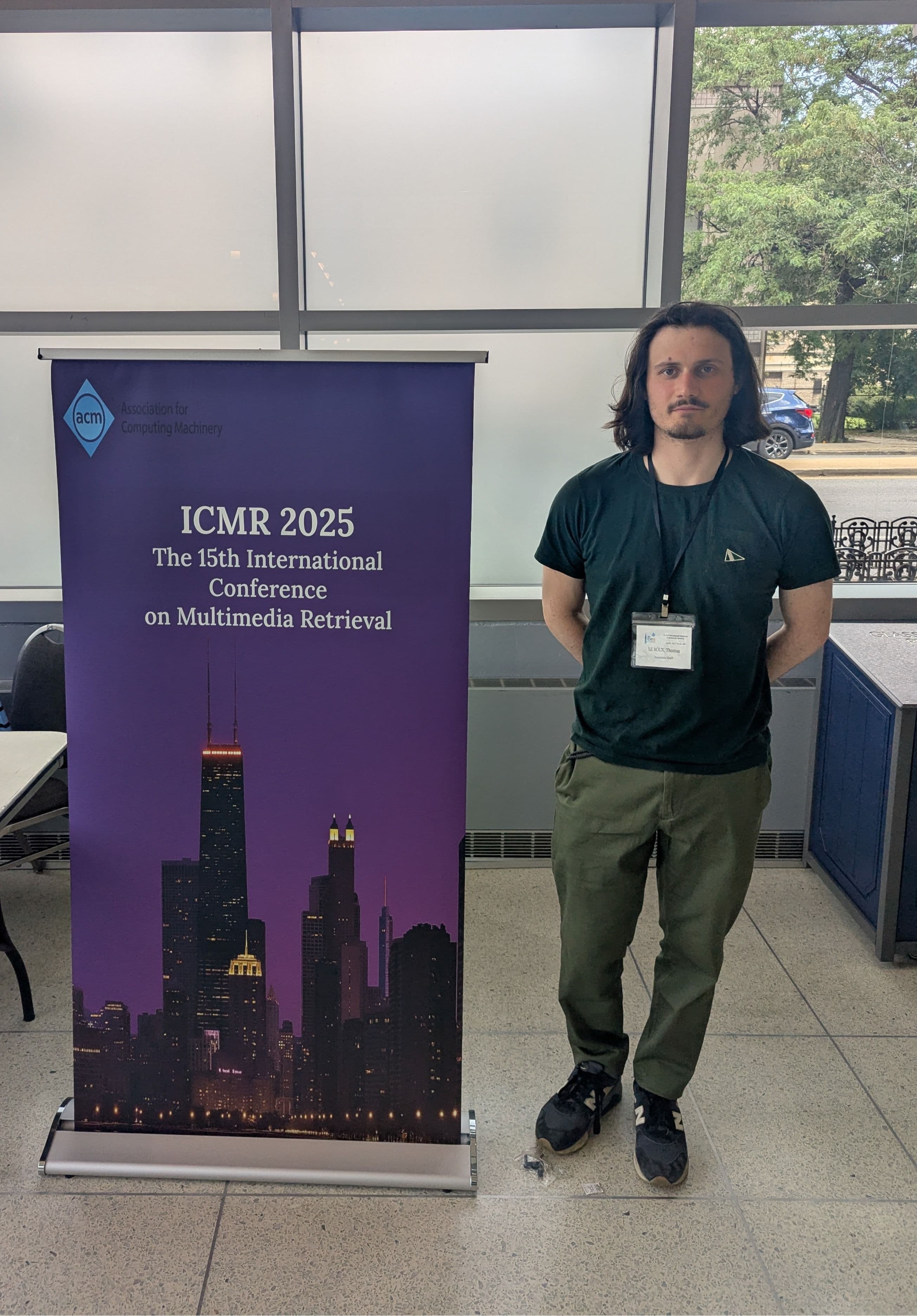
vera.ai's Thomas Le Roux of Fraunhofer IDMT provides a short recap of this year’s workshop in this article.

Following a friendly introduction from the workshop organizers (represented in-person by Dan-Cristian STANCIU of the DeteRel project), Stefanos Papadopoulos from CERTH (also implied in vera.ai) started the workshop with his keynote: “Multimodal Detection of Misrepresented Images”. In his talk, he made an overview of what he worked on in the last few years in the realm of multimodal AI applied to fact-checking and discussed about the various challenges he faced when trying to create an intelligent automated system that would assist fact-checkers. He covered a wide range of topics, from principles behind fact-checking, existing and new datasets, proposing benchmark, managing modalities and developing fact-checking architectures.
Session reports
The first session, titled “Benchmarking and Evaluating Multimodal Misinformation Detection” started with a user study made at TU Berlin for the news-polygraph project. It compared the impact of explanation richness of various AI fact-checking systems on fact-checkers. The researchers found that explanations improved the experience, and that users were very interested in additional information, such as biases and transparency on AI decision-making. The following presentation made by students from Indraprastha Institute of Information Technology Delhi (IIITD) showcased the creation of a multimodal dataset as well as their deepfake detection approach based on identifying a known persona, and the coherence of the content. The last presentation of the session was made by researchers from York University and tackled the problem of class imbalance commonly found in fact-checking datasets and proposed a method to generate new realistic synthetic examples using LLMs.
The second session on “Multimodal Fact-Checking and Deepfake Detection I” started by showcasing the combined use of Graph Neural Network and Sequence Embedding techniques for fact-checking, a work done by the Ruhr-Universität Bochum. A dataset was then introduced by researchers from CERTH: the XDF dataset, a large-scale video deepfake dataset that contains a wide range of different manipulations. It can be used as a standalone training and evaluation source but can also enhance model generalization when used in addition to other training data. This session ended with the presentation of the latest work done by Fraunhofer IDMT: using a Person-of-Interest framework to detect impersonation and misinformation. This framework generalizes well to different datasets, unseen scenarios and real-world cases.
Before the final session, Olga Papadopoulou from CERTH gave an overview about the vera.ai project. The presentation covered the goals, main outcomes as well as the remaining open challenges of the vera.ai project.
The session “Multimodal Fact-Checking and Deepfake Detection II” concluded the day, starting with a presentation from TU Berlin on a multimodal approach to deepfake detection combining image, video and text. They showed the advantage of a multimodal fusion model over an ensemble composed of unimodal classifiers. Finally, the workshop ended with a series of experiments on deepfake attribution models, conducted by researchers from CERTH. They found that attribution models had generalization issues, showcased the importance of contrastive learning for complex architectures, and the importance of having qualitative and diverse data in the training set.
After this intense day, the attendees went to rest, but connections had been made, and the rest of the ICMR conference was spent together, exchanging points of views regarding talks, going out for food and even enjoying a wonderful Chicago firework and sunset together! As a first timer at the MAD workshop, it was very interesting to dig deeper into other aspects of disinformation, notably fact-checking and deepfake detection for other modalities. Giving and receiving feedback, exchanging about problems and discussing potential solutions from other domains specialists was a very interesting brain workout, and those moments will stick with me.
Looking ahead: 5th edition of the MAD workshop (MAD’26)!
Given the current political situation, Chicago was a particularly challenging destination this year, not all participants were able to attend the conference in person due to visa restrictions. The organizers hope that next year’s location will again encourage researchers from around the globe to join the discussion, and to bring new and exciting ideas to the Multimedia AI against Disinformation realm!
As it has become something of a tradition: If you are curious to know where the next MAD workshop will happen, here’s a teaser for next year’s location:

Conference material available
If you want to check out contributions from MAD’25: they can be found on the ACM website!
Author: Thomas LeRoux (IDMT)
Editor: Anna Schild (DW)